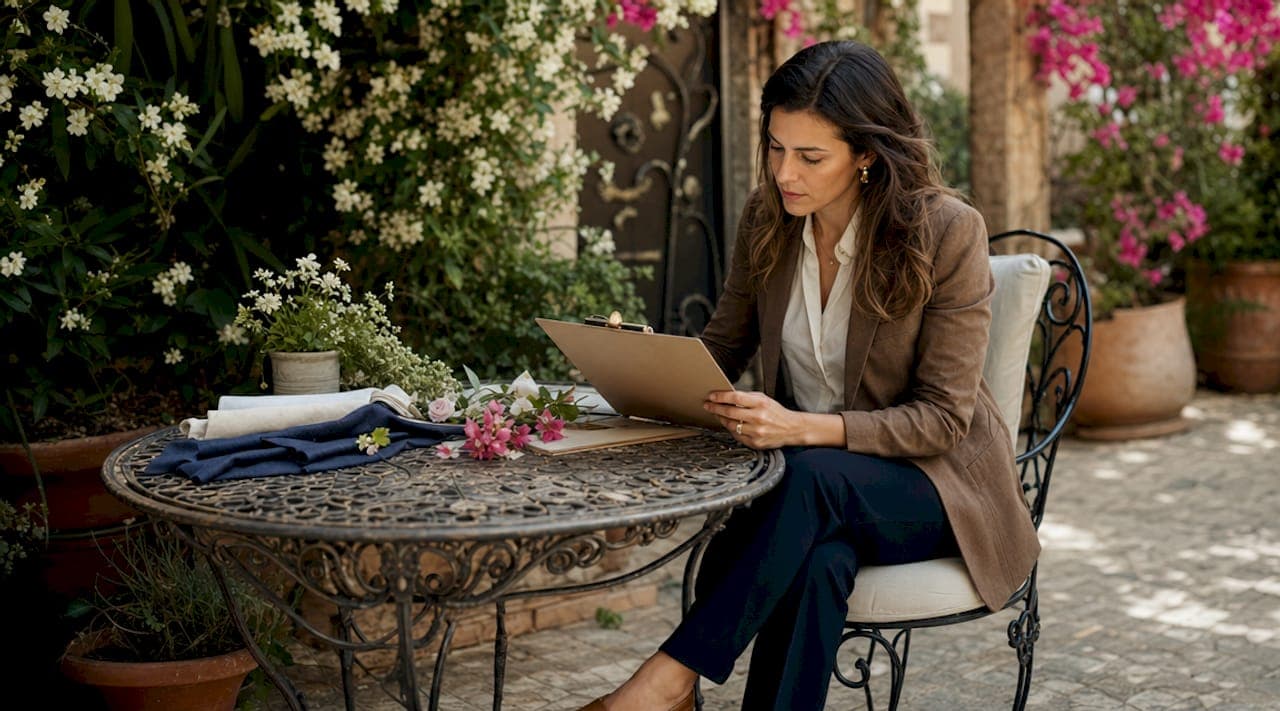
A boutique wedding venue is defined by its intimate size, exclusive atmosphere, and deeply personalized guest experience, making it a distinct alternative to traditional large-scale banquet halls. Unlike conventional event spaces that rotate multiple weddings per weekend, boutique venues focus on atmosphere and character over volume, treating each wedding as the only event that matters. These spaces range from historic manor houses and whitewashed Mediterranean villas to charming boutique inns and converted farmhouses. If you are planning a wedding that feels genuinely yours rather than a production line event, understanding what separates a boutique venue from the rest is the most important decision you will make.
What is a boutique wedding venue, exactly?
A boutique wedding venue is a smaller, curated event space that prioritizes personalized service, distinctive character, and an intimate guest experience over raw capacity. The industry sometimes calls these "intimate wedding spaces" or "exclusive event venues," and both terms capture the same core idea: fewer guests, more attention, and a setting with real personality.
Boutique venues typically host intimate celebrations of 2 to 40 guests, though some extend to 80 or 100 in larger boutique properties. That number is not arbitrary. It reflects a deliberate philosophy: every guest should feel seen, every moment should feel considered, and the venue itself should contribute to the story of the day.
The physical settings vary widely. You will find boutique wedding locations in converted Victorian townhouses, Andalusian countryside estates, coastal inns, and restored historic buildings. What unites them is not architecture but intention. The space is designed to make a small group of people feel like the center of the world, not a crowd moving through a schedule.
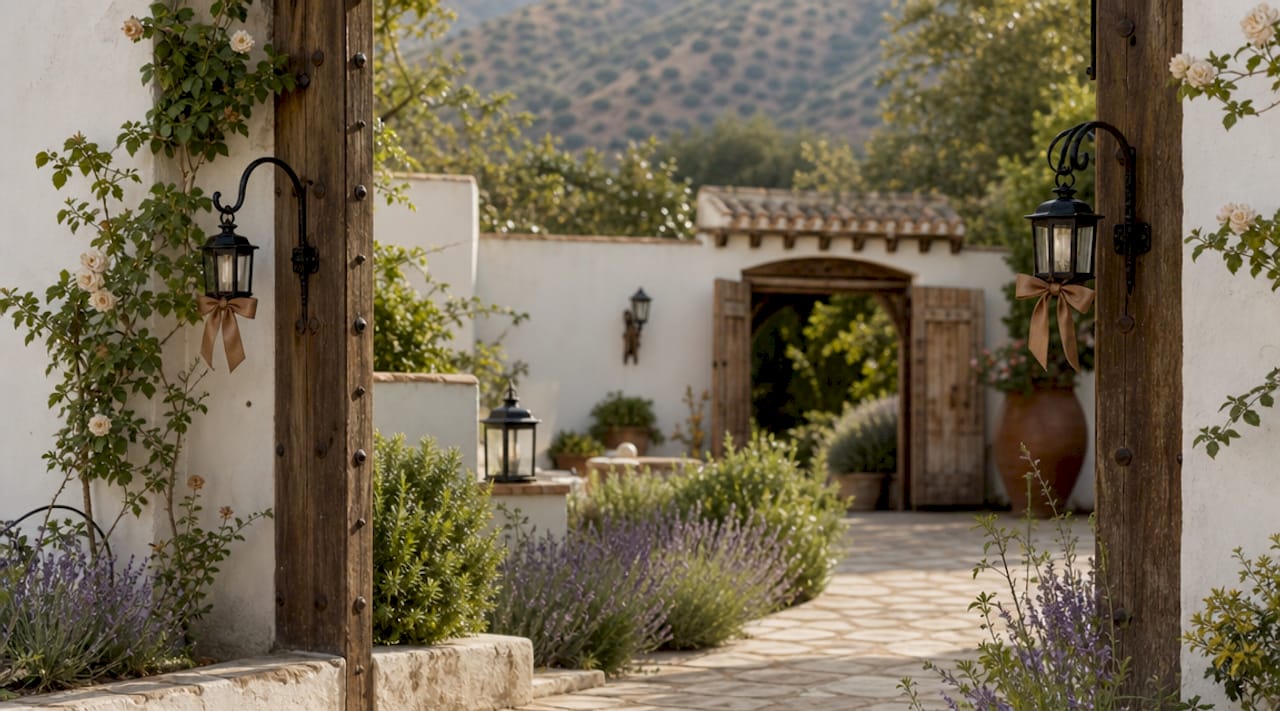
Boutique venues also differ operationally. Most host one event per day, which means the entire staff, the entire kitchen, and the entire property is focused on your wedding and nothing else. That single-event model is the structural reason boutique weddings feel so different from ballroom affairs where three receptions run simultaneously in adjacent rooms.
What are the main benefits of choosing a boutique wedding venue?
The benefits of boutique wedding venues fall into three categories: atmosphere, service, and flexibility. Each one compounds the others to create an experience that larger venues structurally cannot replicate.
Atmosphere that works for you, not against you
Boutique venues carry genuine architectural character. A whitewashed Spanish villa with bougainvillea-covered walls and a rose-tinted pool does not need heavy florals or theatrical lighting to feel special. The setting does the work. This matters practically because your photography, your guest comfort, and your overall aesthetic are all shaped by the bones of the space. Charming wedding venues with real personality give photographers natural backdrops and guests natural conversation starters.
Service that stays focused
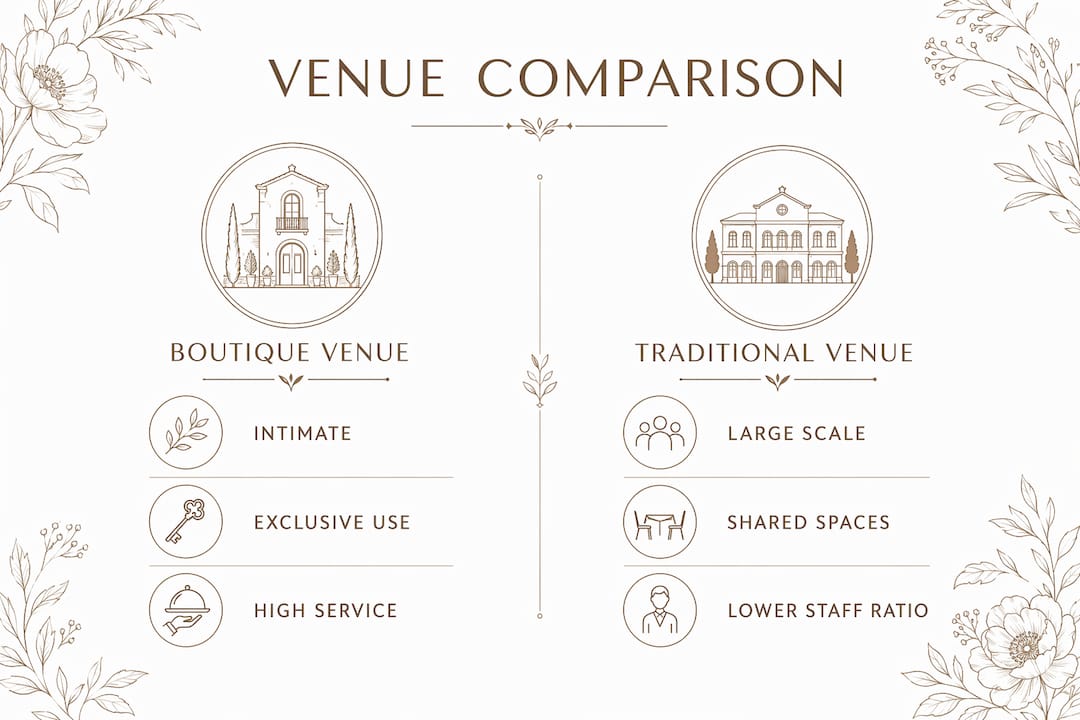
Because boutique venues host one wedding at a time, the staff ratio to guests is dramatically higher than at a large hotel ballroom. Your coordinator is not splitting attention between your cocktail hour and another couple's ceremony down the hall. This focused service model reduces the small logistical failures that accumulate at large venues: the late canapé tray, the missing place card, the sound check that runs into the ceremony.
Multi-day celebrations and wedding weekends
One of the most underappreciated benefits is the ability to build a full wedding weekend. Boutique venues frequently promote rehearsal dinners, main celebrations, and farewell brunches consolidated in one location. This keeps your closest people together, reduces travel logistics, and turns a single day into a genuine experience.
Pro Tip: Ask any boutique venue whether their weekend packages include exclusive use of the property. Some venues still allow day guests or other bookings during your stay, which changes the atmosphere significantly.
Here is a direct comparison to help you weigh your options:
| Feature | Boutique venue | Traditional large venue |
|---|---|---|
| Guest capacity | Typically 2 to 100 | 100 to 500+ |
| Events per day | One | Multiple simultaneous |
| Staff focus | Dedicated to your wedding | Split across events |
| Architectural character | Distinctive and curated | Often generic or neutral |
| Multi-day packages | Common | Rare |
| Vendor flexibility | Varies by venue | Often restricted to preferred list |
How do boutique venues compare with traditional banquet halls?
The most honest comparison between boutique and traditional venues comes down to one question: do you want your wedding to feel like an event or an experience?
Traditional banquet halls and large hotel ballrooms are engineered for throughput. They seat 200 to 500 guests efficiently, they have loading docks for catering trucks, and their staff are trained to execute a standardized timeline across multiple simultaneous bookings. That model works well when scale is the goal. It works poorly when intimacy is.
Boutique venues operate on the opposite logic. Capacity mismatches can cause intimacy to fail, so staying within the venue's recommended guest range is not a suggestion. It is the mechanism by which the boutique experience actually functions. A 40-person venue crammed with 80 guests stops being intimate and starts being uncomfortable.
The flexibility gap is real but nuanced. Boutique venues differ widely in what they allow: some offer all-inclusive packages with curated vendors, others let you bring in any supplier you choose. Traditional venues almost always operate with a preferred vendor list that limits your options. Neither model is universally better, but you need to know which one you are signing up for before you book.
Pros and cons of boutique venues versus traditional venues:
- Boutique pros: Exclusive use, personalized service, distinctive setting, multi-day packages, higher staff-to-guest ratio
- Boutique cons: Lower guest capacity, higher per-head cost at some properties, limited availability due to exclusivity
- Traditional pros: High capacity, established vendor networks, often lower per-head cost at scale, accessible locations
- Traditional cons: Multiple simultaneous events, generic interiors, less personalized coordination, no exclusive-use guarantee
What should couples consider when selecting a boutique wedding venue?
Choosing the right boutique venue requires matching four things: your guest count, your aesthetic, your service expectations, and your budget structure. Getting any one of these wrong creates friction that no amount of beautiful decor can fix.
-
Match your guest list to the venue's capacity. Boutique venues are designed around specific numbers. A venue built for 30 guests will feel strained at 55. Confirm the venue's recommended maximum before you fall in love with the space.
-
Assess the aesthetic alignment honestly. A rustic barn venue and a Mediterranean villa both qualify as boutique, but they create completely different weddings. Look at the venue gallery before visiting in person. If the existing style fights your vision, you will spend significant money trying to override it.
-
Clarify what is included in the package. Boutique venues vary widely on vendor policies and inclusions. Some provide in-house catering, coordination, florals, and accommodations. Others provide the space and nothing else. The difference in total cost between these two models can be substantial.
-
Confirm accommodation arrangements. Boutique hotel wedding venues that offer onsite accommodations reduce stress significantly by keeping your wedding party and closest guests in one place. Ask how many rooms are available and whether they are included in the exclusive-use booking.
-
Ask about dedicated coordination. A wedding day coordinator is not the same as a venue contact. Confirm whether the venue provides a dedicated coordinator for your event or whether you are expected to manage vendor communication yourself.
Pro Tip: Request a sample timeline from the venue for a previous wedding of similar size. This reveals how they actually run an event day, not just how they describe it in a brochure.
How do boutique venues accommodate multi-day wedding celebrations?
The multi-day wedding weekend is where boutique venues genuinely outperform every other venue type. Bundled weekend packages reduce vendor handoffs and timing risks, which is the structural reason multi-day boutique weddings run more smoothly than single-day events at large venues.
The typical structure looks like this: guests arrive on day one for a welcome dinner or rehearsal gathering, the main ceremony and reception take place on day two, and a relaxed farewell brunch closes the weekend on day three. Because everyone is staying on the same property, the energy carries across all three days without the fragmentation that comes from guests dispersing to different hotels.
Multi-day wedding weekend packages enhance guest comfort and create more memorable celebrations precisely because the experience is continuous rather than compressed into a single high-pressure day. Guests have time to connect, the couple has time to breathe, and the venue has time to show its full character.
Here is what a typical boutique venue multi-day package includes:
| Day | Event | Typical inclusions |
|---|---|---|
| Day 1 | Welcome dinner or rehearsal | Venue use, catering, accommodation check-in |
| Day 2 | Ceremony and reception | Full venue, coordination, catering, florals |
| Day 3 | Farewell brunch | Venue use, brunch catering, late checkout |
Pro Tip: When reviewing three-day wedding packages, confirm whether the per-night accommodation rate is included in the package price or billed separately. The difference can run into thousands of dollars.
The scenic route your guests travel to reach a boutique destination venue also becomes part of the experience. Countryside estates and coastal properties turn the journey into anticipation, which sets the emotional tone before anyone arrives.
Key takeaways
A boutique wedding venue delivers an intimate, exclusive experience that traditional large venues cannot replicate because the entire operation is built around one wedding, one day, and one couple at a time.
| Point | Details |
|---|---|
| Core definition | Boutique venues prioritize intimate size, exclusive use, and personalized service over guest volume. |
| One-event model | Hosting one wedding per day means dedicated staff focus and no split-attention service failures. |
| Guest count discipline | Staying within the venue's recommended capacity is what makes the intimate atmosphere actually work. |
| Multi-day advantage | Weekend packages consolidate rehearsal dinners, ceremonies, and brunches into one seamless location. |
| Vendor policy varies | Always confirm what is included and what vendor flexibility the venue allows before signing a contract. |
Why boutique venues are worth the extra thought
I have spent years working with couples at Dragonflydreamweddings, and the pattern I see most often is this: couples who choose a boutique venue for the right reasons have a fundamentally different wedding day than those who choose one simply because it looked beautiful in photographs.
The right reason is that you genuinely want your wedding to feel like a gathering rather than a production. You want your grandmother to be able to hear the speeches. You want your best friend to find you easily during cocktail hour. You want the staff to know your name by the morning of the wedding. These are not small things. They are the things people actually remember.
What I find most telling is how boutique venues handle the unexpected. When a caterer runs late or the weather shifts, a venue with one dedicated team absorbs the problem quietly. A large venue with three simultaneous events and a shared kitchen does not have that capacity. The boutique model is not just more personal. It is structurally more resilient.
The one caution I always give: be honest about your guest list before you fall in love with a space. I have seen couples try to squeeze 70 guests into a venue designed for 45, and the result is that the intimacy they paid for disappears entirely. The venue's capacity recommendation is not a suggestion. It is the engineering spec for the experience you are buying.
— Ms
Experience a boutique wedding at Dragonflydreamweddings
Dragonflydreamweddings is a luxury boutique wedding venue set in the Andalusian countryside near Málaga, Spain, specializing in intimate destination weddings and exclusive three-day celebrations. The property combines whitewashed Spanish architecture, lush gardens, fairy lights, bougainvillea, and a Rose Pool to create a setting that requires no overriding. It is already the wedding you imagined.
Every booking at Dragonflydreamweddings includes dedicated wedding planning expertise from Ms King, who manages coordination, vendor relationships, and timeline management so you do not have to. The venue hosts one wedding at a time, exclusively. If you are ready to explore what an intimate destination wedding in southern Spain looks like for your specific guest count and vision, visit the venue page to begin your inquiry.
FAQ
What is a boutique wedding venue?
A boutique wedding venue is a smaller, intimate event space that hosts one wedding at a time, prioritizing personalized service, distinctive character, and an exclusive atmosphere over high guest volume. These venues typically accommodate between 2 and 100 guests depending on the property.
How many guests can a boutique venue hold?
Most boutique venues specialize in intimate celebrations of 2 to 40 guests, though larger boutique properties can accommodate up to 80 or 100. Staying within the venue's recommended capacity is critical to preserving the intimate experience.
Do boutique venues offer multi-day wedding packages?
Yes. Multi-day packages at boutique venues typically include a welcome dinner, the main ceremony and reception, and a farewell brunch, all consolidated in one location to reduce logistics and enhance guest comfort.
Are boutique venues more expensive than traditional venues?
Boutique venues often carry a higher per-head cost because of their exclusive-use model and higher staff-to-guest ratio. However, all-inclusive packages that bundle catering, coordination, and accommodations can make the total cost comparable to or lower than assembling the same services separately at a traditional venue.
What questions should I ask before booking a boutique venue?
Confirm exclusive use of the property, the venue's maximum guest capacity, what is included in the package, vendor flexibility, and whether a dedicated coordinator is provided. The venue FAQ page at Dragonflydreamweddings covers the most common planning questions for couples considering an intimate destination wedding.
Recommended
- FAQs 1 — Dragonfly Retreat Dream Weddings
- Wedding Planner in Spain – Ms King at The Dragonfly Retreat — Dragonfly Retreat Dream Weddings
- Wedding Planner in Spain – Ms King at The Dragonfly Retreat — Dragonfly Retreat Dream Weddings
- Gallery | Experience Serenity Today — Book Your Wedding — Dragonfly Retreat Dream Weddings