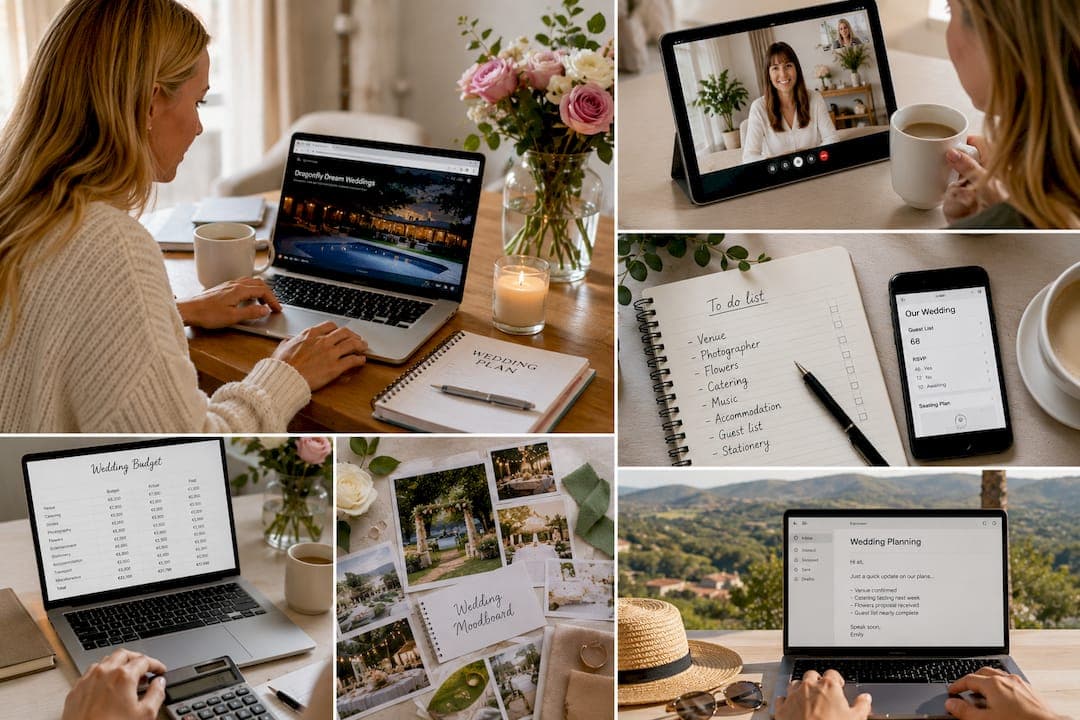
What is remote wedding planning and how does it work?
Planning a wedding from another country can feel overwhelming at first. How do you choose the right venue? Who do you trust? What happens if you can't visit every supplier in person? The good news is that remote wedding planning has transformed destination weddings, allowing couples to organise every detail with confidence from anywhere in the world. With the right planning tools, experienced local professionals and clear communication, your dream wedding can come together beautifully—without the stress of constant travel.

How we make remote wedding planning simple at Dragonfly
At Dragonfly Dream Weddings in Southern Spain, many of our couples live in the UK, Ireland, Scandinavia and across Europe. Most only visit once before their wedding, and some don't visit until the week of their celebration.
We guide couples through every stage using video calls, shared planning documents and regular updates. From choosing menus and flowers to planning accommodation and creating timelines, everything can be organised remotely while still feeling personal and exciting.
Our aim is simple: we want you to enjoy your engagement rather than spend it worrying about logistics.
Your wedding should be about celebrating with the people you love—not spending months feeling overwhelmed by planning. Whether you're organising your celebration from London, Dublin, Helsinki or anywhere else, the right venue and the right team can make the entire journey enjoyable from beginning to end.
If you're dreaming of a relaxed destination wedding in Southern Spain, we'd love to show you how simple remote wedding planning can be.
💡 Pro Tip by Ms King
Don't wait until every detail is perfect before booking your venue. Secure the venue you truly love first, then build everything else around it. The best photographers, celebrants and musicians can often be arranged afterwards—but your dream venue may not be available if you wait too long.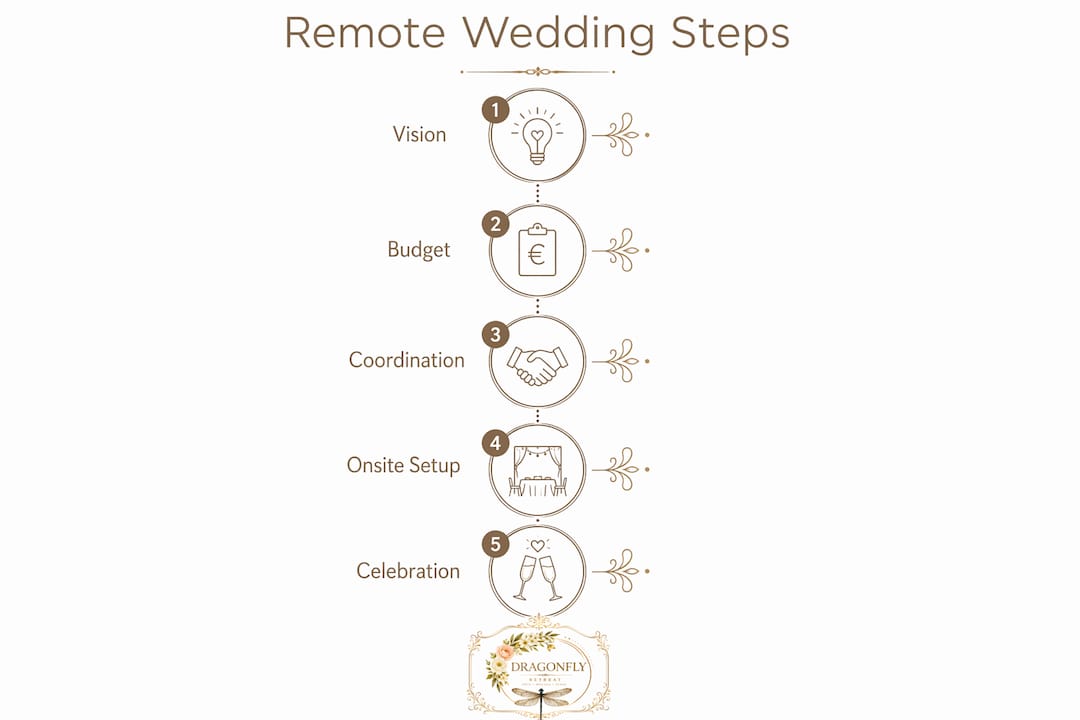
Timeline and design
Build a 12–18 month milestone plan and share it with every supplier from day one. Digital mood boards on platforms like Pinterest give your local team a visual reference for colour palettes, table settings, and floral arrangements. Written specifications must accompany every mood board image. A picture of a centrepiece is not a brief. A picture plus dimensions, flower varieties, and colour codes is a brief.
Pro Tip: Create a single shared document that lists every supplier, their contact details, their deliverable, and the deadline. Share it with your local coordinator and update it after every call. This one habit prevents most remote planning misunderstandings.
How does on-site presence integrate with remote coordination?
On-site presence is not optional in remote wedding planning. It is the mechanism that converts months of virtual work into a real event. A local coordinator or planner arrives at the venue days before the wedding to manage what cannot be managed by email.
Here is how the on-site integration typically works:
-
Pre-arrival vendor confirmation. Your coordinator contacts every supplier in the final week to confirm arrival times, quantities, and setup requirements. This catches errors before they become problems.
-
Venue setup oversight. The coordinator arrives on-site to supervise the physical setup of décor, catering, and audio-visual equipment against your written specifications.
-
Day-of timeline management. The coordinator holds the master timeline and keeps every supplier on schedule throughout the event.
-
Cultural and language liaison. Local cultural and communication differences require a planner who understands regional business norms, not just the local language. A shared language is insufficient if the planner does not understand how local suppliers prefer to work.
-
Legal and permit compliance. Local regulations around noise, catering licences, and civil ceremony paperwork vary by region. Your on-site coordinator navigates these without pulling you into bureaucratic detail.
Pro Tip: Ask your local coordinator to send a short video walkthrough of the venue setup the morning of the wedding. It takes five minutes and gives you confidence that everything matches the plan.
The planner’s on-site arrival days in advance is standard practice for destination weddings. That lead time is not a luxury. It is the buffer that absorbs the inevitable last-minute surprises.
What are the main challenges and misconceptions about remote wedding planning?
The biggest misconception about remote wedding coordination is that your planner must live near the venue. What matters is experience, local partnerships, and the ability to handle international travel and local legal requirements. A well-connected planner based in London can organise a flawless wedding in Andalusia if they have the right local network and have done it before.
Other common challenges include:
-
Limited physical venue visits. Most couples planning a wedding from afar visit the venue once, if at all, before the day itself. Virtual tours and drone footage address this directly, but you must trust the technology and your coordinator’s judgement.
-
Reduced last-minute flexibility. Remote weddings require earlier decisions and more detailed written specifications because there is less flexibility for changes on site. If you decide three weeks before the wedding that you want a different floral arrangement, your local supplier may not have the stock or the time.
-
Communication gaps. Time zone differences and language barriers create delays. A single point of contact who manages all supplier communication on your behalf removes most of this friction. Without one, you risk receiving contradictory information from multiple suppliers.
-
Over-reliance on visuals without written specs. Mood boards inspire. Written specifications instruct. Suppliers work from instructions, not inspiration.
-
Underestimating local bureaucracy. Civil ceremony requirements, noise permits, and catering regulations differ significantly between countries and even between municipalities. Missing a permit can delay or cancel a ceremony.
The couples who struggle most with remote planning are those who try to manage every detail themselves from a distance. The couples who succeed are those who hire the right local team and then let them work.
How can couples make remote wedding planning work in practice?
The most effective shift you can make is from micromanagement to collaboration. Burnout from over-control is a common issue in remote planning. Couples who try to approve every minor decision by email create delays, frustrate suppliers, and exhaust themselves. The solution is to define your non-negotiables clearly at the start and then empower your local coordinator to handle everything else.
Practical steps that work:
-
Start at least 12–18 months out. Venue availability, legal paperwork, and popular suppliers book up fast. Starting early gives you options.
-
Establish one central communication platform. Whether that is WhatsApp, Slack, or a dedicated planning app, all decisions should live in one place. Scattered communication across email, text, and phone calls creates gaps.
-
Choose suppliers experienced with destination and remote weddings. A local caterer who has never worked with an overseas couple will not understand why you need written confirmations of everything. One who has will send them without being asked.
-
Schedule regular virtual check-ins. A fortnightly video call with your coordinator keeps the plan on track and surfaces problems before they grow.
-
Share a detailed vision document. Write down your priorities, your non-negotiables, and your preferred aesthetic. Give this to every key supplier at the start.
Pro Tip: Before signing any supplier contract, ask them to describe how they have worked with remote couples before. Their answer tells you immediately whether they understand what you need.
Structured and frequent communication updates mitigate the risk of misunderstandings in remote planning. The couples who treat communication as a system, not a series of ad hoc calls, consistently report better outcomes. You can explore common planning questions to understand what experienced remote couples typically ask before committing to a venue.
Remote wedding planning: what I have learned from working with couples from afar
The couples who approach remote planning with the most confidence are rarely the ones who have planned the most. They are the ones who have chosen the right local team and then genuinely trusted them.
The hardest part of remote planning is not the logistics. It is the psychological shift of accepting that you cannot see everything in person. Couples sometimes spend hours on video calls trying to replicate the experience of being there physically. That energy is better spent writing a precise brief and then stepping back.
Technology has genuinely changed what is possible. Drone footage, digital floor plans, and high-resolution photography give couples a level of spatial understanding that was not available a decade ago. But technology is a tool, not a substitute for a skilled local coordinator who knows the venue, the suppliers, and the regional way of working.
The pitfall I see most often is couples who choose a venue based on photographs alone, without asking the right questions about logistics, access, and local regulations. A beautiful venue that cannot accommodate your guest count or lacks the right permits is not a beautiful venue. It is a problem.
The rewarding truth is that a well-executed remote wedding often feels more personal than a locally planned one. Because you have had to articulate your vision so precisely, every detail reflects a deliberate choice. Nothing is left to chance or last-minute improvisation.
— Dragonfly
Planning your wedding in Spain with Dragonflydreamweddings
Dragonflydreamweddings specialises in intimate destination weddings near Málaga, at The Dragonfly Retreat in Andalusia. The venue accommodates up to 18 guests for lodging and hosts weddings of up to 60 attendees, making it well suited to couples who want an exclusive, personal celebration rather than a large-scale event.
[IMAGE:cta_image]
Remote couples benefit from Dragonflydreamweddings’ established local vendor network, professional on-site coordination, and a planning process built around clear communication and detailed specifications. You can browse the wedding venue packages to understand what is included, or visit the venue gallery to get a visual sense of the space before committing to a call. For couples ready to talk through their vision, the wedding planner at The Dragonfly Retreat brings the local expertise that makes remote planning genuinely work.
Key takeaways
Remote wedding planning succeeds when couples combine a precise written vision with a trusted local coordinator who has the experience, network, and authority to execute it on the ground.
| Point | Details |
|---|---|
| Timeline starts at 12–18 months | Remote decisions need more lead time; book venue and key suppliers first. |
| Local coordinator is non-negotiable | On-site presence days before the wedding manages setup, suppliers, and last-minute issues. |
| Written specs outperform mood boards | Suppliers work from instructions; always accompany visuals with written detail. |
| Single communication platform | Centralise all decisions in one place to prevent gaps and contradictions. |
| Collaboration beats micromanagement | Define non-negotiables early, then empower your local team to handle the rest. |
FAQ
What is remote wedding planning in simple terms?
Remote wedding planning is the process of organising a wedding from a distance using digital tools and a local coordinator, without needing to be physically present at the venue throughout the planning period.
How long does remote wedding planning take?
Planning timelines typically span 12–18 months for remote and destination weddings. This lead time accounts for legal requirements, supplier availability, and the additional communication needed when coordinating across distances.
Does my wedding planner need to live near the venue?
No. A planner’s experience, local partnerships, and knowledge of regional legal requirements matter far more than their home address. Many highly effective destination wedding planners operate internationally.
How do couples choose a venue without visiting it?
Drone footage, digital floor plans, and virtual walkthroughs give couples a near in-person understanding of a space. Pairing these tools with a detailed site visit checklist reviewed by your local coordinator covers most of what a physical visit would reveal.
What is the biggest risk in remote wedding planning?
The biggest risk is poor communication, specifically scattered approvals, vague specifications, and no single point of contact. A remote planner acting as a single point of contact shields couples from supplier confusion, language barriers, and time zone delays.