
One person. One phone number. One voice that every supplier calls when something needs deciding. That is what a single point of contact (SPOC) does at a wedding, and it is the single most underrated piece of planning infrastructure a couple can put in place. The SPOC manages all vendor communication, owns the run-of-show, and makes on-the-day decisions so the couple can stay present rather than fielding calls from the caterer about table linen.

The role is most commonly filled by a professional wedding planner or coordinator, though a dedicated venue coordinator or a highly organised, trusted friend can step in with the right briefing. Each option carries trade-offs covered in full below.
Three duties the SPOC must own:
- Vendor liaison: single channel for all supplier questions, confirmations, and deliveries
- Run-of-show management: calling cues, managing timing buffers, and coordinating transitions
- Troubleshooting: authorising minor changes and escalating anything that needs the couple's decision
The single most important action you can take right now: appoint your SPOC, confirm their authority in writing, and share that name with every supplier before the wedding day.
Pro Tip: Put the SPOC's name and mobile number at the top of every supplier contract and briefing document. Vendors who know exactly who to call will never interrupt the couple.
Table of Contents
- What does a 'single point of contact' actually mean for a wedding?
- What core responsibilities must the SPOC handle?
- What are the real benefits of having a single point of contact?
- Who should you appoint as the single point of contact?
- How do you choose the right SPOC for your wedding?
- Sample day-of timeline and checklist your SPOC should use
- What an 'on-the-day' coordinator does not do
- How Dragonfly Dream Weddings acts as your single point of contact
- Key takeaways
- Why the SPOC role matters more than most couples realise
- Planning a destination wedding weekend with a SPOC included
- Useful sources and where to read more
- FAQ
What does a 'single point of contact' actually mean for a wedding?
In everyday business language, a SPOC is simply the one authorised person a team routes all queries through. In a wedding context, the meaning is more specific: the SPOC is the operational lead for the event, the person with authority to make logistical decisions on the couple's behalf and the first call every supplier makes when something changes.
This is distinct from three related roles couples often confuse:
- Wedding planner: involved from early in the planning process, managing budgets, sourcing suppliers, and shaping the overall vision. Often the strongest SPOC candidate because they already know every contract.
- Venue coordinator: employed by the venue to protect the venue's interests, manage its staff, and uphold health and safety. Venue coordinators are focused on the venue's assets and safety; they do not usually have authority to represent the couple in vendor negotiations or design decisions.
- Show caller or MC: responsible for audience-facing announcements and entertainment flow, not supplier logistics.
Typical queries that route to the SPOC rather than the couple:
- The catering team needs to know whether to delay the first course by fifteen minutes because guests are still arriving.
- The AV technician wants confirmation of the first dance track before the band's sound check.
- A florist arrives thirty minutes early and needs to know where to park and which entrance to use.
- A last-minute seating change is needed because two guests have had a falling-out.
A formal SPOC becomes non-negotiable for multi-day or destination weddings, large guest lists above sixty people, and venues that explicitly require a named decision-maker in their contracts. For a three-day wedding weekend in southern Spain, where suppliers may arrive across two days and the schedule runs from rehearsal dinner through to farewell brunch, having a single authorised contact is not a luxury. It is the only way the day holds together.
What core responsibilities must the SPOC handle?
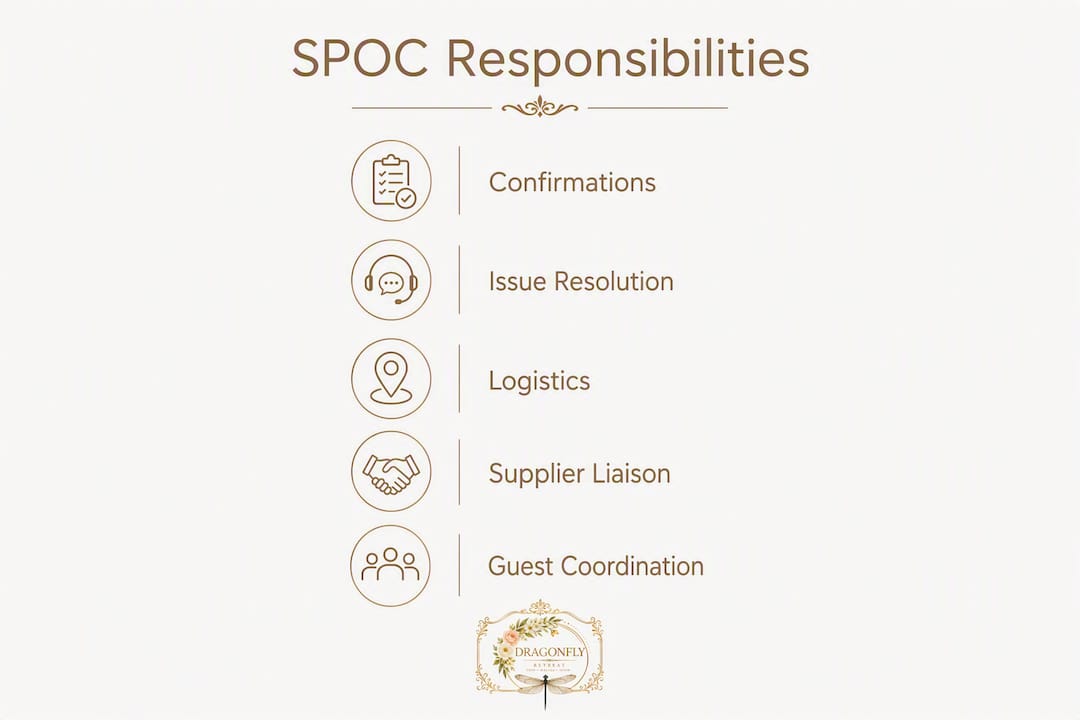
The SPOC role is broader than most couples expect. A coordinator's practical duties include converting plans into an executable run-of-show, running vendor logistics, calling cues, and protecting the couple's attention through discrete problem resolution. Here is what that looks like in practice:
- Vendor liaison and confirmations: The SPOC sends final briefing documents to every supplier in the week before the wedding, confirms arrival times, and fields all day-of queries through a single channel.
- Timeline and run-of-show ownership: They call every cue, from the processional music to the cake cutting, and manage the buffers built into the schedule so a fifteen-minute delay in the ceremony does not cascade into a cold dinner.
- Logistics and setup oversight: Deliveries, signage placement, table plans, personal effects (bouquets, rings, order-of-service cards) all pass through the SPOC before the couple sees them.
- Troubleshooting and contingency decisions: Minor changes, such as moving a drinks reception indoors due to weather, are authorised by the SPOC without interrupting the couple. Major issues are escalated with a clear recommendation, not a problem dump.
- Post-event wrap-up: The SPOC confirms vendor departure times, handles lost property, oversees the return of hired items, and may manage final gratuity envelopes or outstanding payments.
| Responsibility | Who it affects | When it happens |
|---|---|---|
| Final supplier confirmations | All vendors | 5 days before |
| Run-of-show distribution | Venue, catering, AV, photography | 1–2 weeks before |
| Setup and delivery oversight | Florist, décor, stationery | Morning of the wedding |
| Cue calling | Band/DJ, photographer, catering | Throughout the day |
| Contingency decisions | Any supplier | As needed |
| Post-event wrap-up | Venue, hired suppliers | Evening and next morning |
The quiet, preventative work of coordinators resolving issues before they are noticed is what separates a calm wedding day from a stressful one. Most of the SPOC's best work is invisible to the couple and guests.
What are the real benefits of having a single point of contact?
The most obvious benefit is that the couple stops being the switchboard. A designated single point of contact acts as the primary liaison for all wedding vendors, fielding questions and handling logistical issues on the wedding day so the couple can remain present. Without a SPOC, the photographer, the caterer, and the florist all have the couple's number, and they will use it.
For the couple:
- No supplier interruptions during the ceremony, portraits, or first dance
- Decisions are made by someone briefed on their preferences, not guessed at
- Hiring a coordinator redirects 8–12 hours a week of planning time away from couples who would otherwise manage logistics themselves
For vendors and venue staff:
- One clear instruction source prevents conflicting directions from well-meaning family members
- Faster problem resolution because the SPOC has authority to decide, not just relay
- Suppliers can focus on their craft rather than chasing approvals
For guests:
- Consistent, accurate information about timings and locations
- Quicker handling of special requests (dietary needs, accessibility, seating queries)
- A calmer atmosphere when the couple is visibly relaxed
Pro Tip: Brief your SPOC on two or three things that would genuinely upset you if they went wrong, such as the wrong song for the first dance or a specific allergy at the top table. Those are the non-negotiables they protect above everything else.
For destination weddings in particular, the guest experience benefits compound across multiple days. Read more in this guide to destination wedding guest experience for practical ideas on keeping guests informed and comfortable throughout a multi-day celebration.
Who should you appoint as the single point of contact?
The answer depends on the complexity of your wedding and how much authority the person can realistically hold. Wedding planners are usually the ideal SPOC because they know the couple's vision, vendor contracts, and logistical requirements; family members often lack authority and can be overburdened.

Option 1: Professional wedding planner or coordinator
The strongest choice for any destination or multi-day wedding. They arrive with existing supplier relationships, a copy of every contract, and the professional authority to make decisions without second-guessing. Their loyalty is entirely to the couple, not the venue.
Option 2: Venue coordinator
Valuable for venue-specific logistics but limited in scope. A venue coordinator will manage the catering team, the room layout, and the venue's own staff, but they are not positioned to chase an external florist or authorise a change to the photographer's timeline. Use them as a partner to the SPOC, not a replacement.
Option 3: Trusted friend or family member
Possible for smaller, simpler weddings, but the pitfalls are real. A friend who is also a guest will be pulled in two directions. A family member may lack the authority to tell a supplier no. If you go this route:
- Choose someone who has no other role on the day (not the best man, not a bridesmaid)
- Give them a written brief, a printed run-of-show, and every supplier's contact details
- Walk through the timeline with them at least two weeks before the wedding
Combining roles: For larger weddings, a practical split is to have a professional SPOC manage all supplier communication while a trusted friend or family member acts as the couple's personal contact for emotional support and personal logistics. The two roles do not overlap if the brief is clear.
Pro Tip: Whatever you decide, confirm the SPOC's authority in writing with the venue and in a brief email to every supplier. "All day-of decisions go through [Name] on [number]" takes thirty seconds to send and prevents hours of confusion.
How do you choose the right SPOC for your wedding?
Selection criteria matter more than title. A coordinator with five years of experience at intimate venues may be less suited to a three-day destination weekend than a planner with two years of experience specifically in multi-day events.
What to look for:
- Organisation: Can they produce a detailed run-of-show without prompting? Ask to see a sample from a previous event.
- Vendor experience: Do they have existing relationships with suppliers in your area, or will they be working with strangers?
- Decision authority: Are they comfortable saying no to a supplier or redirecting a family member who tries to take over?
- Calmness under pressure: Ask them directly: "Tell me about a time something went wrong at a wedding you coordinated. What did you do?"
- Availability for handover: Effective day-of coordinators often provide month-of services, starting 4–8 weeks before the wedding to create the run-of-show and perform handovers. A coordinator who only commits to the morning of the wedding is not offering a full service.
Questions to ask at interview:
- How do you handle a supplier who arrives late and is affecting the timeline?
- What happens if the weather forces a last-minute change of ceremony location?
- How do you communicate with the couple during the day without interrupting them?
- Who covers for you if you are ill on the morning of the wedding?
- What does your handover process look like in the weeks before the event?
Red flags:
- Cannot provide supplier references or a sample run-of-show
- Hesitates when asked who makes decisions if the couple is unavailable
- Has cancelled or rescheduled initial meetings more than once
- Quotes a day-of-only service with no prior planning involvement
On pricing: Day-of or month-of coordination fees vary considerably across Europe and depend on the scale of the event. What matters contractually is not the fee structure but whether the contract names the SPOC explicitly and confirms their decision authority. A coordinator without named authority in the contract is a coordinator whose decisions suppliers can ignore.
Sample day-of timeline and checklist your SPOC should use
The table below is a compact run-of-show template for a one-day ceremony within a three-day wedding weekend. Adapt timings to your own schedule. For a full luxury wedding weekend itinerary, including rehearsal dinner and farewell brunch timings, see the linked guide.
| Time | SPOC action | Priority |
|---|---|---|
| — | Confirm all supplier arrival times by message | Critical |
| — | Greet venue staff; walk the ceremony and reception spaces | Critical |
| — | Receive florist delivery; check against brief | Critical |
| — | Confirm catering timeline with head chef | Critical |
| — | Check AV setup; confirm first dance track with DJ/band | Critical |
| — | Distribute final run-of-show to all on-site suppliers | Critical |
| — | Confirm photographer and videographer positions for ceremony | Important |
| — | Cue processional music; signal officiant | Critical |
| — | Manage drinks reception flow; brief catering on first course timing | Critical |
| — | Cue guests to dining room; confirm seating plan is in place | Critical |
| — | Cue speeches; brief photographer | Important |
| — | Cue cake cutting; coordinate with catering | Important |
| — | Cue first dance; signal band/DJ | Critical |
| — | Confirm supplier departure times; collect hired items | Important |
| Next morning | Lost property check; final venue walkthrough; gratuity envelopes | Optional |
SPOC checklist grouped by supplier:
- Catering: final guest count confirmed, dietary requirements distributed, service timing agreed
- Photography and video: shot list received, key moments flagged, access to getting-ready space confirmed
- Florals: delivery time, placement plan, bouquet and buttonhole storage location
- Music: playlist or set list approved, cue words agreed, volume levels checked
- Venue staff: setup complete by agreed time, emergency contacts exchanged, contingency spaces identified
For destination and multi-day events, the SPOC should be involved from the rehearsal dinner the evening before, confirming the welcome drinks timing, the rehearsal order, and the following morning's breakfast arrangements. A guide to remote wedding planning covers how to manage supplier communication when you are coordinating from abroad in the months before the event.
What an 'on-the-day' coordinator does not do
The term "day-of coordinator" is widely used and widely misunderstood. The term is often misleading; effective coordinators typically begin four to eight weeks before the event to build the run-of-show and conduct handovers. But even with that extended involvement, there are clear limits to the role.
What falls outside the SPOC's scope:
- Full design decisions, such as choosing florals, colour palettes, or décor themes. These belong to the planning phase, not the day itself.
- Long-term contract negotiation with suppliers. The SPOC works with contracts already signed, not in place of a planner who negotiates them.
- Legal or licencing responsibilities, including marriage registration, civil ceremony paperwork, or noise curfew compliance. These are the venue's and the couple's responsibility.
- Managing the couple's personal finances or making payments beyond pre-agreed gratuities.
- Acting as a therapist or mediator for family conflict. The SPOC can redirect and de-escalate, but sustained interpersonal issues are outside their brief.
Why a last-minute hire has limits:
A coordinator hired two weeks before the wedding has not attended supplier meetings, does not know the venue layout, and has not built the run-of-show from scratch. They can manage the day competently, but they cannot replicate the institutional knowledge a planner builds over months. The 4–8 week handover period is the minimum for a coordinator to do the role properly.
Capturing scope in the contract:
Any task outside the standard brief should be written into the contract as an explicit add-on, with a fee attached. If you want the SPOC to manage final vendor payments, collect and return hired items, or handle the farewell brunch the following morning, say so in writing before the wedding day.
How Dragonfly Dream Weddings acts as your single point of contact
At Dragonfly Dream Weddings, the in-house coordinator steps into the SPOC role from the moment a couple books their three-day wedding weekend. This is not a handover that happens a week before the event. It is a continuous relationship that runs from the first planning consultation through to the farewell brunch on Sunday morning.
The venue's exclusive-use model makes the SPOC structure particularly effective. Because no other wedding is taking place on the property, the coordinator's attention is entirely on one couple and their guests. Every external supplier, from the Málaga-based caterers to the flamenco musicians and the floral designers, receives a single briefing document and a single point of contact number. For destination or multi-day weddings, naming a single authorised decision-maker in contracts prevents conflicting instructions and protects contract integrity. Dragonfly builds this into every contract as standard.
What the coordinator manages across the three days:
- Rehearsal dinner logistics, including welcome drinks timing and guest arrivals from nearby accommodation
- Ceremony cues in the Mediterranean gardens or Dragonfly Hall, including processional music, officiant briefing, and photography positions
- Pool party and informal events around the Rose Pool, coordinating catering, music, and guest flow
- Farewell brunch setup and supplier departure on the final morning
On exclusive-use coordination: When a venue hosts only one wedding at a time, the coordinator's authority is unambiguous. There is no competing event, no shared catering team, and no confusion about whose timeline takes priority. That clarity is what allows a three-day celebration to feel effortless rather than managed.
The boutique on-site accommodation for up to 20 guests means the coordinator can manage the morning schedule, breakfast timings, and getting-ready logistics without anyone needing to travel. For larger groups, nearby accommodation is arranged in advance, with the SPOC coordinating transport and arrival times. Weddings of up to 100 guests are accommodated, and the coordinator scales the supplier briefing accordingly.
For couples planning from the UK or Ireland, the destination weddings in southern Spain guide explains the regional supplier landscape and what to expect from the planning process before the handover period begins.
Key takeaways
A professional SPOC, appointed early and given named authority in writing, is the single most effective way to protect the couple's experience and keep a wedding day running on time.
| Point | Details |
|---|---|
| Appoint early | Confirm your SPOC at least 4–8 weeks before the wedding to allow proper handover and run-of-show creation. |
| Confirm authority in writing | Name the SPOC in every supplier contract so vendors know exactly who makes decisions on the day. |
| Choose by complexity | A professional coordinator is the strongest choice for destination or multi-day weddings; a venue coordinator alone is rarely sufficient. |
| Know the limits | Day-of coordination does not include design decisions, contract negotiation, or legal responsibilities. |
| Dragonfly Dream Weddings | Dragonfly's in-house coordinator acts as the named SPOC across the full three-day wedding weekend, from rehearsal through to farewell brunch. |
Why the SPOC role matters more than most couples realise
The conventional wisdom is that a wedding coordinator is a luxury, something couples add when the budget allows. That framing gets it backwards. The SPOC is not a comfort purchase. It is the operational infrastructure that makes every other supplier investment pay off.
Think about what happens without one. The photographer does not know whether to follow the couple or stay with the guests during the drinks reception, so they ask the bride. The caterer cannot get a decision on whether to hold the first course, so they serve it anyway and it arrives cold. The florist leaves the bouquet in the wrong room because no one told them where the couple was getting ready. None of these are catastrophic individually. Together, across a full day, they accumulate into the low-grade chaos that makes couples say afterwards that the day "felt rushed" or "didn't go quite to plan."
The SPOC's real value is not in managing the expected. It is in absorbing the unexpected before it reaches the couple. A seasoned coordinator notices that the ceremony chairs are set two rows short before any guest sits down. They spot that the band has not been briefed on the extended drinks reception and quietly extend the set. They intercept the well-meaning uncle who has decided to give an impromptu speech and redirect him warmly but firmly.
What couples often underestimate is the handover period. Four to eight weeks sounds like a long time, but that is when the coordinator reads every contract, maps every supplier's arrival window, and builds the run-of-show that holds the day together. A coordinator hired the week before the wedding is working without that foundation. The day may still go well, but the margin for error is far thinner.
Planning a destination wedding weekend with a SPOC included
Three-day wedding weekends in southern Spain involve more moving parts than a single-day event, and the coordination requirement scales accordingly. Dragonfly Dream Weddings includes an in-house wedding coordinator as part of every three-day wedding package, covering the full arc from rehearsal dinner to farewell brunch.
The coordinator manages the complete supplier network, from local Andalusian caterers and live musicians to photographers and floral designers, so couples arriving from the UK or Ireland are not managing a foreign supplier list from a distance. Boutique on-site accommodation for up to 20 guests is built into the venue, with additional nearby accommodation arranged for larger groups, and the coordinator handles the logistics of both.
To see the venue, meet the team, and understand exactly how the SPOC role works across a full weekend, book a private viewing or browse the full package details at Dragonfly Dream Weddings. The team recommends making contact at least twelve months before your preferred date to allow enough time for the planning handover.
Useful sources and where to read more
The following sources informed this article and are worth reading if you want to go deeper on specific aspects of wedding coordination:
- Why we insist on a single point of contact for every wedding and event — The Belltower on 34th — A venue's perspective on why named decision authority in contracts protects everyone involved, particularly for multi-day events.
- Destination weddings in southern Spain: your venue guide — Dragonfly Dream Weddings Regional planning guidance for couples considering a destination wedding in Málaga and the surrounding area.
FAQ
What does a single point of contact do at a wedding?
A single point of contact manages all supplier communication, owns the run-of-show, and makes on-the-day logistical decisions so the couple can remain present. Every vendor query routes through them rather than to the couple.
Who is the best person to be the wedding contact on the day?
A professional wedding planner or coordinator is the strongest choice, particularly for destination or multi-day weddings, because they already know every contract and have the authority to make decisions on the couple's behalf. A venue coordinator can support but is not a substitute.
What are the main benefits of having a single contact for your wedding?
The primary benefits are fewer interruptions for the couple, faster problem resolution for suppliers, and a calmer guest experience. Coordinating through one person also prevents conflicting instructions reaching the catering or venue team.
When should the SPOC get involved in wedding planning?
Effective coordinators typically begin 4–8 weeks before the wedding to build the run-of-show and conduct supplier handovers. A coordinator who only arrives on the morning of the wedding is working without the preparation that makes the role effective.
Does Dragonfly Dream Weddings provide a single point of contact?
Yes. Dragonfly Dream Weddings includes an in-house coordinator as the named SPOC across every three-day wedding weekend, managing suppliers, timelines, and logistics from the rehearsal dinner through to the farewell brunch.