
Ask these eight questions in your first conversation: Are you available on my wedding date? What exactly is included, and what isn't? What are your fees, and what's the payment schedule? Who will actually be at my wedding? How many weddings have you coordinated, and can I speak to past clients? What's your contingency plan if something goes wrong? Do you work exclusively with certain vendors or venues? What are your cancellation and postponement terms?
These are not arbitrary. Each one exposes a different way a coordinator relationship can quietly fall apart, and each has a clear right answer versus a wrong one. A coordinator who hesitates on availability, gets vague about inclusions, or can't name a single reference by the second question is telling you something important before you've even discussed the flowers.
- Availability & blackout dates. A coordinator juggling three other weddings that same weekend cannot give you their full attention, no matter how good their portfolio looks.
- Scope of services. "Day-of coordination" can mean anything from six hours of on-site management to a single phone call the week before. You need it in writing.
- Fees, deposit and payment schedule. Coordinator fees typically run from around $800 to $3,000 depending on market and scope, according to a breakdown of coordinator duties and pricing, so a quote wildly outside that range deserves a direct question about what's driving it.
- Who attends on the day. The person you interview and the person who shows up can be two different people if you don't ask.
- Experience and references. Years in business matter less than the number of weddings actually run, particularly at your guest count and format.
- Contingency and insurance. Rain plans, vendor no-shows and illness are not edge cases. They are Tuesday for a working coordinator.
- Vendor relationships and impartiality. Coordinators are sometimes paid commission by vendors or venues, which can quietly shape their recommendations.
- Cancellation and postponement policy. Life happens. You want to know the financial consequences before you need to know them.
Ask all eight in a 10 to 15 minute phone screen before booking a longer meeting. A coordinator who answers cleanly and specifically deserves your time. One who talks around the questions, especially on fees or who attends, has told you what you need to know without saying it directly.
Key takeaways
The strongest wedding coordinator interviews combine a structured question bank, a written scoring rubric and verified references before any contract is signed.
| Point | Details |
|---|---|
| Lead with the top eight questions | Cover availability, scope, fees, attendance, experience, contingency, vendor impartiality and cancellation terms first. |
| Score candidates, don't just chat | Rate each coordinator 1 to 5 across availability, clarity, fees, responsiveness and fit after every call. |
| Verify with references, not portfolios | Ask past clients about problem-solving and payment transparency, not just overall satisfaction. |
| Get every clause in writing | Request scope, payment schedule, substitution and insurance clauses before signing anything. |
| Consider an integrated venue model | Dragonfly Dream Weddings pairs an in-house coordinator with a three-day, exclusive-use format for up to 100 guests. |
Table of Contents
- Questions to ask wedding coordinators: a printable interview checklist
- The full question bank: what to ask by category
- How to run the interview and score your shortlist
- Venue coordinator or independent coordinator: what's the difference?
- Getting the contract right: clauses worth requesting
- Checking references properly and spotting red flags early
- How a coordinator keeps your budget on track
- How a coordinator keeps the timeline on track during the wedding itself
- Publisher perspective: what a destination venue changes about coordination
- How Dragonfly Dream Weddings can help you plan with confidence
- Sources
- FAQ
Questions to ask wedding coordinators: a printable interview checklist
Bring a checklist to every meeting rather than trusting memory, particularly once you're on your third or fourth call and details start to blur. A simple printed sheet with space for notes and a rating scale turns a friendly chat into a proper evaluation.
Score each coordinator from 1 to 5 on five core criteria immediately after the call, while the conversation is still fresh:
- Availability — did they confirm your date without hedging, and did they mention any other events that weekend?
- Clarity of services — could they describe exactly what's included without you having to ask three follow-up questions?
- Fee transparency — did they give a real number, or a vague range that expanded when you pushed for specifics?
- Responsiveness — how long did it take them to reply to your initial enquiry, and did they answer the phone call on time?
- Cultural and personal fit — did you feel comfortable telling them something had gone wrong on your wedding day, hypothetically?
For a 20 to 25 minute phone screen, focus on availability, fees and one reference request. That's usually enough to sort a shortlist of five down to two or three. Save the deeper questions, timeline management, vendor relationships, contingency detail, for the 60 to 90 minute in-person or video interview, where you have time to hear full answers rather than headlines.
Pro Tip: Print three copies of your checklist before your first call and fill one in immediately afterwards, while the details are fresh. Comparing three completed sheets side by side after a week of calls is far more useful than trying to recall which coordinator said what.
A coordinator scoring 4 or above across the board after the in-depth interview is a genuine contender. Anything averaging below 3 after two conversations rarely improves on a third.
The full question bank: what to ask by category
Different weddings need different depths of questioning. A local, single-day wedding with a known venue needs less scrutiny on logistics than a three-day destination celebration with guests flying in from three countries. Use the categories below to build your own shortlist rather than asking every question to every candidate.
Availability and scheduling
- Are you free on my exact wedding date, including the days either side for setup and breakdown?
- Do you have any other events booked that same weekend, and if so, who covers mine if there's a clash?
- When do you typically start active planning, and when do you finalise the timeline?
- How far in advance do you need final vendor confirmations?
A strong answer names specific dates and a specific handover process. A weak one is a general "we'll make it work."
Services and scope
- What exactly is included in day-of coordination versus partial or full planning?
- What is explicitly not included in this package?
- Do you handle vendor bookings, or only manage vendors I've already hired?
- Will you attend my final walkthrough at the venue?
Listen for a written scope document offered unprompted. That's a good sign. A coordinator who describes their service only in adjectives, "we handle everything," "stress-free," is one you should push harder on specifics.
Fees, payment and cancellations
- What is your total fee, and what does it cover?
- What is the deposit amount, and when are subsequent payments due?
- Are there additional fees for overtime, extra meetings or travel?
- Are you paid a flat fee, or do you also earn commission from vendors or the venue?
Commission arrangements aren't automatically a problem, but they should be disclosed. As destination-planning specialists note, planners compensated through vendor commissions may have an incentive to steer you toward particular suppliers, so ask directly.
Experience and references
- How many weddings have you coordinated in total, and how many in the last twelve months?
- Have you worked with a wedding of my size and format before?
- Can I speak with two or three recent clients?
- Have you personally coordinated at this specific venue before?
Team composition and vendor contacts
- Who will physically be present on my wedding day, by name?
- If it's not you, when do I meet that person?
- Will I have a single point of contact throughout planning and on the day?
- Do you have existing relationships with vendors in this area?
Day-of operations and timeline control
- What does your setup and breakdown schedule look like on the day?
- How do you manage the minute-by-minute timeline once the ceremony starts running late?
- Who fields questions from guests so I don't have to?
- What's your process if a vendor arrives late or not at all?
Contingency, insurance and permits
- What's your contingency plan for bad weather or a vendor cancellation?
- Do you carry event or liability insurance, and does it extend to my venue's location?
- Have you handled a genuine emergency at a wedding before, and what happened?
- Do you assist with permits if the venue or location requires them?
Logistics: load-in, rehearsal, breakdown
- What are the venue's rules on load-in times and décor handling?
- Do you run the rehearsal, and is that included in your fee?
- Who manages breakdown, and are there overtime charges if it runs long?
Destination-specific questions
- Have you worked in this country or region before, or will you rely on local subcontractors?
- How do you handle payments in a foreign currency?
- Do you coordinate guest travel and accommodation, or is that a separate service?
- Will you visit the venue in person before the wedding weekend?
Destination-planning guides consistently flag whether a planner personally visits the venue as one of the most revealing questions you can ask, since a coordinator relying entirely on local partners may miss site-specific quirks that only become obvious in person.
Communication style and response times
- How quickly do you typically respond to emails or calls?
- What's our regular meeting cadence between now and the wedding?
- Who is my point of contact if you're unreachable?
Problem-solving and past examples
- Tell me about a wedding where something went wrong. What did you do?
- What's the most difficult vendor situation you've handled?
How to run the interview and score your shortlist
A disciplined interview process has three stages, and skipping any of them is how couples end up signing with someone who looked great on a first call but fell apart under pressure.
- Pre-screen call (10 to 15 minutes). Cover availability, ballpark fees, and basic scope. Eliminate anyone who fails on the first two.
- In-depth interview (45 to 75 minutes). Work through the category-based questions relevant to your wedding. This is where you assess team composition, contingency planning and vendor relationships in real detail. Event-design specialists recommend using this stage to confirm whether the coordinator offers full-service planning and exactly who will attend your wedding, rather than assuming the person you're speaking to is the person who shows up.
- Reference checks and a venue walkthrough. Call at least two references and, where possible, do an in-person or virtual walkthrough of a venue they've worked at before.
Score each finalist using a weighted rubric once you've completed all three stages:
- Availability (weight: essential, pass or fail)
- Clarity of scope (weight: 25%)
- Fee transparency (weight: 20%)
- References (weight: 25%)
- Personal fit (weight: 15%)
- Contingency planning (weight: 15%)
If Coordinator A scores 4 on scope, 5 on fees, 4 on references, 5 on fit and 3 on contingency, that's a weighted average of roughly 4.15. Coordinator B might score higher on fit but lower on contingency and references, landing at 3.6. The rubric doesn't replace instinct, but it stops a warm personality from masking a genuine gap in experience.
Pro Tip: Write down anything that felt evasive during the first call, even something minor, and revisit it during the reference check. A coordinator who was vague about "who typically attends" often turns out to send a junior assistant rather than the lead you interviewed. References usually confirm or deny this within one question.
Venue coordinator or independent coordinator: what's the difference?
This is one of the most misunderstood distinctions in wedding planning, and it matters enormously for what you can and can't expect from each.
An independent coordinator is hired by you, works for your interests, and typically manages every external vendor relationship and the full timeline. A venue coordinator, by contrast, is employed by the venue itself. Their job is to manage the facility, oversee in-house catering where it exists, and protect the venue's operational interests, not necessarily to advocate for your vision across the board.
| Factor | Venue coordinator | Independent coordinator |
|---|---|---|
| Who they work for | The venue | The couple |
| Scope | Facility operations, in-house catering, venue logistics | Full event, all external vendors, overall timeline |
| Vendor relationships | Limited to venue's approved or in-house suppliers | Broader network, often chosen with your preferences in mind |
| What they typically won't do | Manage external vendors, personal timeline details, guest logistics | Facility maintenance or venue-specific technical operations |
| Typical involvement | Usually begins closer to the event, focused on the day itself | Often involved from early planning through to the wedding day |
Venue coordinators: strengths and limits
- Deep familiarity with the specific space, its quirks, its layout and its rules.
- Usually included in the venue fee, so no separate cost.
- Limited scope: they generally won't chase your florist, manage your photographer's schedule, or handle guest accommodation questions.
Independent coordinators: strengths and limits
- Full advocacy for your interests, from budget to guest experience to vendor selection.
- Can work across multiple venues and coordinate a multi-day celebration end to end.
- An added cost, and their quality varies enormously since anyone can call themselves a coordinator.
For an exclusive-use, multi-day destination wedding, the two roles often work best in tandem, or through a venue that has genuinely integrated the coordinator function into the property itself rather than treating it as a bolt-on service. A venue offering a single point of contact for the entire weekend removes much of the ambiguity that comes from splitting responsibility between two separate coordinators who've never met.
Getting the contract right: clauses worth requesting
A verbal promise means nothing once the wedding is six weeks away and something has changed. Every point discussed in your interviews should appear, in some form, in the written contract.
Ask your solicitor to review the agreement, but come prepared with a checklist of what should be in it:
- A detailed scope of services, listing exactly what's included and, just as importantly, what isn't.
- Named personnel: who is the lead coordinator, and what happens if they're unavailable.
- The full payment schedule, including deposit amount, milestone payments and the final balance date.
- Cancellation and refund terms, tiered by how far ahead of the wedding the cancellation occurs.
- Overtime fees, stated as a clear rate rather than "to be discussed."
- Liability insurance details, including whether cover extends to your specific destination.
Request a substitution-of-personnel clause specifically. It should state who steps in if your named coordinator becomes unavailable, and confirm that the replacement has been briefed on your event in advance, not just handed a file on the morning.
Some clauses are more negotiable than others. Payment currency, travel and accommodation costs for a planner working internationally, and the use of local subcontractors are all reasonable points to discuss and adjust. Cancellation policies and insurance coverage, however, tend to be fixed by the coordinator's own business insurance and legal advice, so expect less flexibility there. Destination advice consistently flags checking legal requirements and insurance cover as one of the top must-ask items before signing anything, particularly when travel disruption could affect the event itself.
- Force majeure wording that names travel disruption specifically, not just generic "acts of God" language.
- A clear description of deliverables, not just services, so you know what a finished handover looks like.
- Indemnity terms that spell out what happens if a vendor fails to show up entirely.
Checking references properly and spotting red flags early
A reference call is only useful if you ask better questions than "were they good?" Past clients are usually happy to talk, and a coordinator who resists giving you two or three names has already told you something.
Ask former clients:
- Did the coordinator solve a problem you didn't expect on the day?
- Were they easy to reach throughout planning?
- Did the final invoice match what was originally quoted?
- How did they handle vendors who underdelivered or ran late?
- Would you hire them again for a second event?
Watch for these warning signs during your interviews and reference calls:
- Vague or shifting answers about who will actually be on-site on your wedding day.
- No written contract, or reluctance to put fee details in writing.
- Refusal or excessive delay in providing references.
- An unclear or unusually rigid cancellation policy with no room for discussion.
- No mention of liability insurance, or evasiveness when you ask about it.
Beyond the reference calls, do your own quick verification. Ask for a sample timeline from a previous wedding to see how detailed their planning actually gets. Request vendor contact details so you can independently confirm the relationship exists. And spend twenty minutes reading recent online reviews and looking at real event photos, not just polished portfolio shots, since the gap between the two sometimes tells its own story.
How a coordinator keeps your budget on track
Budget adherence is less about restricting spending and more about visibility. A coordinator managing your budget properly gives you a live, itemised breakdown rather than a single lump-sum estimate, so you can see exactly where money is going before it's spent, not after.

Ask how they track spending against the original budget, and how often you'll receive updates. A coordinator who reviews the budget monthly, or after every major vendor booking, catches overspend early enough to correct course. One who only revisits the numbers a few weeks before the wedding leaves you no room to adjust.
Cost-saving measures worth asking about directly include whether they negotiate vendor rates on your behalf, whether they can suggest lower-cost alternatives for non-priority elements without compromising the parts that matter most to you, and whether they flag when a request is likely to blow past your ceiling before you commit to it. A coordinator experienced with multi-day celebrations often has a sharper sense of where costs quietly accumulate, extra staffing hours, breakdown overtime, additional guest transport, because they've seen those line items catch other couples off guard before.
How a coordinator keeps the timeline on track during the wedding itself
The wedding day timeline is the coordinator's real test. Planning documents are easy to write months in advance. Holding that plan together when the ceremony starts fifteen minutes late, the caterer needs another twenty minutes, and your photographer wants an extra ten for portraits is a different skill entirely.

Ask how they handle a delay in the first hour of the day. A coordinator with a genuine process will describe a buffer built into the schedule, often referred to informally as a built-in cushion, so that a small delay in one part of the day doesn't cascade through the rest. They'll also explain who they communicate with first when something shifts, usually the catering team and the venue, since those two are most affected by timing changes.
A strong coordinator treats the timeline as a living document on the day itself, adjusting quietly and communicating changes to vendors without involving you unless a decision genuinely needs your input. That's the entire point of having someone dedicated to the day: you shouldn't be checking your watch or fielding questions from the catering team during your own reception.
Publisher perspective: what a destination venue changes about coordination
At Dragonfly Dream Weddings, we think about coordination differently because our format is different. A three-day wedding weekend, with everyone staying together on-site, changes what a coordinator actually needs to manage compared with a single-day event where guests scatter to hotels afterwards.
Our exclusive-use venue near Coín offers boutique accommodation for up to 20 guests on-site, with additional accommodation nearby allowing celebrations of up to 100 guests in total. That structure means our in-house coordinator isn't just managing a ceremony and reception on one afternoon. They're overseeing arrivals, a welcome gathering, pool time at the Rose Pool, the ceremony itself, and a farewell brunch, all within the same private setting, across three days. The Mediterranean gardens and the wider grounds aren't just backdrops; they're spaces our coordinator has to sequence carefully so that photography, catering timing and guest flow all work together without anyone feeling rushed.
An in-house coordinator embedded in a single venue for years develops a different depth of knowledge than someone parachuting in for a single day. They know exactly how long it takes to reset Dragonfly Hall between the ceremony and the reception, where the light falls best in the gardens at different points in the afternoon, and how the property's authentic Andalusian character, natural stone, olive trees, candlelight, actually photographs and flows across a full weekend rather than a single event slot.
If a three-day, privately staffed wedding weekend with your closest guests staying together sounds like the kind of celebration you're picturing, we'd genuinely encourage you to see it in person. You can book a private viewing or request our brochure to understand exactly how a weekend like this comes together.
How Dragonfly Dream Weddings can help you plan with confidence
Compared with piecing together a venue, a separate coordinator and multiple accommodation bookings yourself, Dragonfly Dream Weddings gives you one dedicated in-house coordinator already familiar with every corner of the property, no need to interview a stranger and hope they learn your venue's quirks in time.
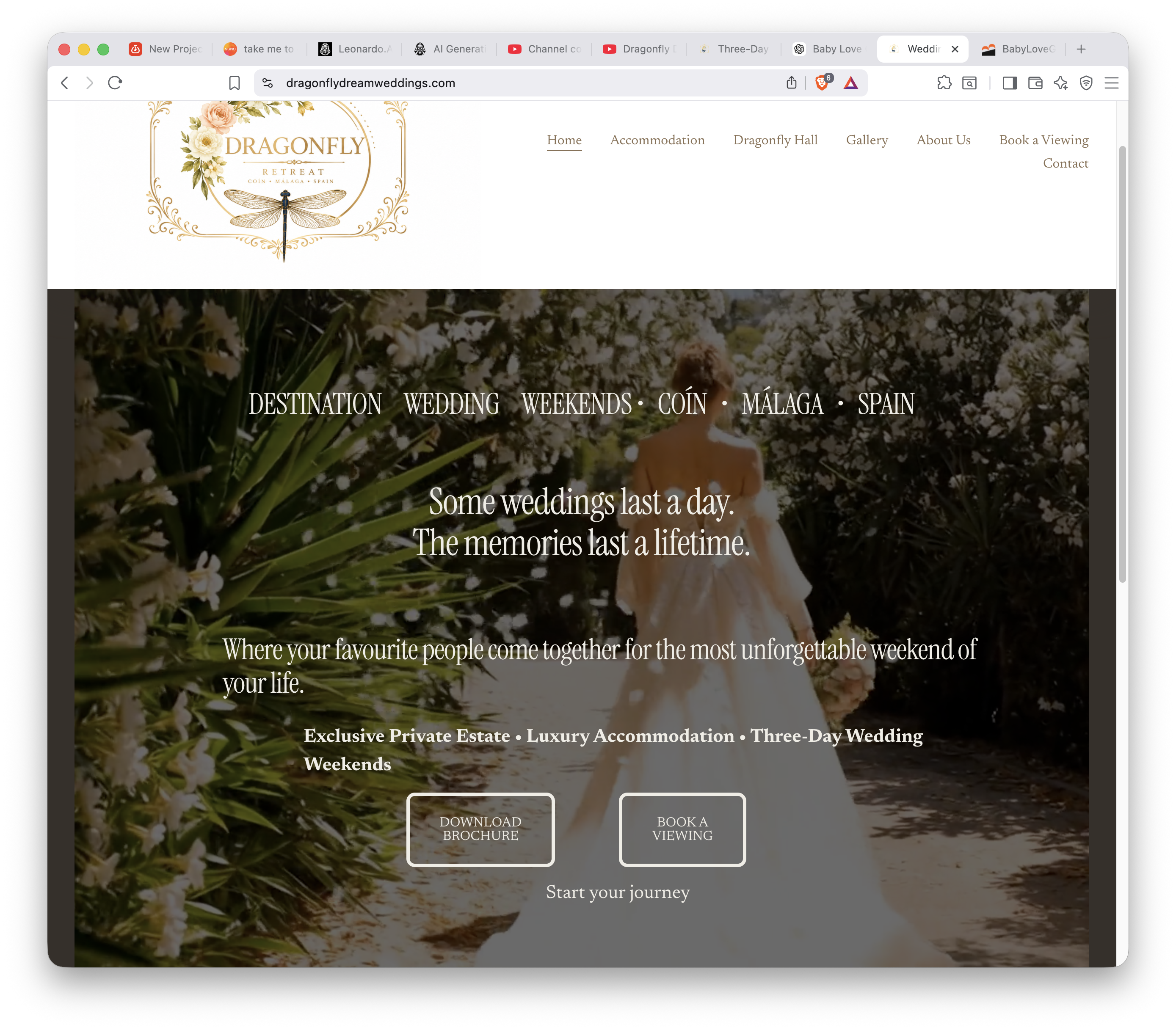
We offer exclusive three-day wedding weekends with full-service planning built in from your first enquiry through to your final farewell brunch. Boutique on-site accommodation houses up to 20 guests in complete privacy, with additional accommodation nearby for weddings of up to 100 guests. Our coordinator works with a network of trusted local suppliers across catering, décor, music and photography, all vetted through years of running events on this specific property, so you're never wondering whether a vendor has actually seen the Rose Pool or the Mediterranean gardens in person.
If you'd like to see the venue for yourself, explore our three-day wedding packages and get in touch to arrange a viewing. We'll walk you through exactly how a weekend at Dragonfly comes together, from arrival to farewell brunch.
Sources
- 37 Essential Questions to Ask When Interviewing a Destination Wedding Travel Planner
- Destination Wedding: 10 Questions to Ask Your Wedding Planner - Cassia Thomas
- 8 Questions to Ask Your Destination Wedding Planner Candidates
- 10 must-ask questions for your destination wedding planner - The Official Website of The Bahamas
- What Does a Wedding Coordinator Do? A Full Breakdown
FAQ
What are good questions to ask in a wedding coordinator interview?
Ask about availability on your date, exactly what's included and excluded, fees and payment schedule, who attends on the day, experience and references, and their contingency plan for problems.
What's the 30-minute rule for weddings?
There's no single universal standard, but many coordinators build a buffer into the timeline between key moments, such as ceremony and reception, so a small delay doesn't cascade through the rest of the day.
What should I ask for in an event coordinator job interview?
If you're evaluating someone for an event coordinator role rather than hiring them for your wedding, focus on their experience with events of your scale, how they've handled a real crisis, and how they communicate with clients under pressure.
What's the difference between a venue coordinator and an independent wedding coordinator?
A venue coordinator works for the venue and manages facility operations, while an independent coordinator works for you and manages your full vendor list and timeline; some destination venues, including Dragonfly Dream Weddings, integrate a dedicated in-house coordinator into the venue experience itself.
How much does a wedding coordinator typically cost?
Coordinator fees commonly range from around $800 to $3,000 depending on market and scope, so always ask for a detailed breakdown of what's included in the quoted figure.