
Wedding professionals outsource planning primarily to reclaim billable time, access specialist skills they cannot cost-effectively hire full-time, and absorb seasonal demand spikes without taking on permanent staff. The practical outcome is straightforward: fewer hours lost to admin, more capacity for high-value creative work, and a business that can grow without burning out the people running it.
If any of these apply to you right now, outsourcing is worth acting on:
- Inquiry response times are slipping past 24 hours during busy periods
- You have turned down bookings because the diary is full, not because the dates are gone
- Your team is exhausted by October and dreading the spring rush
The commercial case is equally clear. Planners who delegate predictable, process-driven tasks — admin, vendor outreach, RSVP tracking — consistently report more bookings, steadier margins, and lower staff turnover. As industry experts note, outsourcing tightens systems so planners can dedicate authentic energy to creative and relationship-driven work rather than routine administration.
Key takeaways
Professionals outsource wedding planning to recover billable time, access specialist skills, and scale capacity without permanent hires, and the business case holds when systems and SLAs are in place before delegation begins.
| Point | Details |
|---|---|
| Audit before outsourcing | Map your weekly tasks and identify which are process-driven before choosing what to delegate first. |
| Systems precede delegation | Document your workflow as an SLA or runbook before handing any task to an external partner. |
| Vet every supplier rigorously | Require a COI, wedding references, a backup plan, and a signed GDPR-compliant contract from every outsourced partner. |
| Protect client-facing moments | Pricing conversations, creative approvals, and on-site lead roles should remain with your core team. |
| Dragonfly Dream Weddings | Offers planners trusted local supplier access and in-house coordination across three-day luxury wedding weekends in Southern Spain. |
Table of Contents
- Why professionals outsource wedding planning: the tasks that move first
- How outsourcing changes your revenue, capacity and team
- How do you outsource without diluting your brand?
- What questions should you ask when vetting a supplier or VA?
- What do outsourced services typically cost, and when should you engage them?
- What should your contracts and SLAs actually include?
- How Dragonfly Dream Weddings uses selective outsourcing
- What experienced planners have learned about outsourcing
- Dragonfly Dream Weddings: a venue built for planners who think this way
- Sources
- FAQ
Why professionals outsource wedding planning: the tasks that move first
Not every task is worth delegating, and not every task should stay in-house. The following breakdown maps the most commonly outsourced work, the trigger that signals it is time to hand it over, and the one situation where it belongs with your core team.
-
Client inquiry triage and admin. A wedding planning virtual assistant handles first-response emails, qualification questions, and CRM updates efficiently. Outsource when reply times exceed 24 hours. Keep it in-house when a prospect is at the final decision stage and expects your voice.
-
Vendor coordination and outreach. Chasing quotes, confirming availability, and managing supplier threads is time-consuming and largely process-driven. Outsource once you have more than three active weddings in production simultaneously. Keep it in-house for new supplier relationships that require your personal credibility to establish.
-
Day-of running and logistics. A specialist day-of coordinator or second planner manages the run sheet on the ground. Outsource for weddings where you are also the creative lead and cannot split attention. Keep it in-house when the couple has specifically contracted you for on-site presence.
-
RSVP management and seating. Repetitive, detail-heavy, and easy to systematise. Outsource from the moment guest numbers exceed 30. Keep it in-house only when seating involves sensitive family dynamics the couple has briefed you on personally.
-
Timeline and run-sheet drafting. Automation tools draft the skeleton; a VA reviews and personalises before client delivery. This human-in-the-loop approach is often the most scalable pattern for timeline work. Outsource the drafting; retain final approval.
-
Social media scheduling. Content batching and scheduling suits a VA or freelance social manager well. Outsource when posting has fallen behind by more than two weeks. Keep it in-house when a story involves a real couple who has not yet approved the content.
-
Bookkeeping and invoicing. A freelance bookkeeper or accountant is almost always more cost-effective than an in-house hire for small planning businesses. Outsource from day one if possible. Keep it in-house only if your business model requires real-time financial decisions daily.
-
Travel and accommodation logistics. Guest transfer schedules, hotel blocks, and airport coordination for destination weddings are highly process-driven. Outsource to a travel coordinator or specialist VA. Keep it in-house when accommodation is part of your venue's exclusive package and requires direct liaison with the property.
-
Catering coordination. Specialist catering partners can manage seasonal menus and complex meal logistics, reducing on-site planning burden considerably for multi-day events.
-
Specialist design and stationery. Graphic designers, calligraphers, and florists are natural outsource partners. Outsource the execution; retain the creative brief and client approval.
Hybrid note: Many planning businesses run a VA for admin plus an in-house lead for all client-facing decisions. That split protects the personal service standard while freeing roughly 8–12 hours per week for higher-value work.
How outsourcing changes your revenue, capacity and team
The business case for outsourcing rests on a simple lever: every hour recovered from admin is an hour available for billable work or business development.
- Increased billable hours. Admin-heavy planners often spend 30–40% of their working week on tasks a VA could handle. Reclaiming even a fraction of that time opens capacity for additional consultations, site visits, or design work.
- Predictable capacity. A managed VA service or retained freelancer gives you a known resource level going into peak season, rather than scrambling for cover in March.
- Improved margins. Outsourcing at a lower hourly rate than your own billing rate generates a direct margin improvement on every hour redirected.
- Reduced recruiting overhead. Hiring, training, and managing a permanent employee carries significant cost and risk. Outsourced support scales up and down without those commitments.
- Lower peak-season risk. A specialist day-of coordinator on a day-rate contract removes the liability of an under-resourced team on a high-stakes weekend.
- Staff wellbeing and retention. Burnout is a measurable business cost. Teams that are not routinely overwhelmed in October stay longer, perform better, and require less re-training.
Profitability example: A VA handling inquiry triage and vendor outreach for 10 hours per week at a modest hourly rate frees the lead planner to take one additional wedding booking per season. At typical destination wedding values, that single booking covers the VA's annual cost many times over. The leverage point is small — a few recovered hours compound quickly into meaningful revenue.
When advising couples on budget allocation, the 50/30/20 wedding budget framework offers a useful structure: splitting spend across essentials, experience, and flex items helps planners identify where coordination costs sit and how outsourcing might affect the overall budget picture.
How do you outsource without diluting your brand?
Outsourcing can actually improve the client experience when the right systems are in place. The risk is not delegation itself; it is delegation without documentation.
Before handing over any task, build a short handover pack:
- Brand voice guide. Two pages covering tone, preferred phrases, and what never to say in client communications.
- Templates. Approved email responses, inquiry scripts, and timeline formats that carry your voice even when someone else is typing.
- Escalation rules. A clear list of situations that must come back to you immediately: pricing queries, complaints, creative decisions, and anything involving the couple directly.
- Approval gates. Any client-facing document goes through you before it is sent, at least during the first three months of a new outsourcing arrangement.
- Brand touchpoints list. The specific moments — welcome calls, final timeline reviews, on-site greetings — that must always involve you or a named senior team member.
Pro Tip: Set up a single point of contact workflow where the client always communicates with one named person on your team, even when a VA is doing the background work. The single point of contact model prevents the fragmented experience that makes outsourcing feel impersonal.
Certain interactions should never be fully delegated: sensitive pricing conversations, high-value creative approvals, and any moment where the couple is making an emotionally significant decision. These are the moments that define your reputation.
What questions should you ask when vetting a supplier or VA?
Vetting reduces operational risk and protects your reputation. A supplier who fails on a peak weekend reflects on you, not on them. Run every candidate through this framework before committing.
Vetting checklist:
- Current certificate of insurance (COI) and public liability cover
- At least two wedding-specific references, with contact details you can actually call
- Documented backup plan if they are unavailable on the contracted date
- Sample run sheet or timeline they have produced for a previous client
- Signed contract with clear payment terms, cancellation clauses, and scope of work
- Explicit GDPR and data handling policy, particularly for any role involving guest data
Interview questions that reveal real experience:
- Describe a wedding where something went wrong on the day. What did you do?
- How do you handle a vendor who is running 30 minutes late on a tight timeline?
- What is your process for handing back to the lead planner at the end of your scope?
- How do you manage communication when you are covering multiple events in the same weekend?
- Walk me through how you would handle a guest data request under GDPR.
Red flags to walk away from:
- No COI or vague insurance claims
- References who cannot speak to wedding-specific work
- No documented backup arrangement
- Inconsistent communication during the vetting process itself
- Reluctance to sign a formal contract or share data handling procedures
What do outsourced services typically cost, and when should you engage them?
Three pricing models cover most outsourcing arrangements in the wedding industry.
Hourly or freelance. The lowest cost per hour, but the planner carries all vetting, management, and continuity risk. Best for one-off tasks or low-stakes support where backup is not critical.
Retainer or managed VA service. A higher hourly rate, but the agency handles vetting, replacement cover, and quality assurance. Managed VA services convert the risk of a single freelancer vanishing into predictable continuity, which matters when peak weekends cannot be missed.
Project or day-rate for specialists. Fixed-fee arrangements for defined deliverables: a day-of coordinator, a designer, a photographer. Predictable cost, clear scope, no ongoing management overhead.
| Pricing model | Cost shape | Reliability | Onboarding effort |
|---|---|---|---|
| Hourly / freelance | Lowest per hour | Variable | High — you vet and manage |
| Retainer / managed VA | Higher per hour | High | Low — agency handles cover |
| Project / day-rate | Fixed per deliverable | High for defined scope | Medium — brief and contract |
When to engage support:
- First missed or delayed booking inquiry due to workload
- Two consecutive weeks of late replies to active clients
- Peak-season forecast showing more than 80% diary capacity
- A new service line that requires skills you do not currently have in-house
Allow at least six to eight weeks to onboard any outsourced partner before your high season begins. Rushing onboarding is the single most common reason outsourcing arrangements fail in the first three months.
What should your contracts and SLAs actually include?
Clear SLAs and runbooks convert variable suppliers into reliable partners. Without them, you are managing by goodwill rather than by agreement. As industry insiders warn, scaling without documented SOPs magnifies operational weaknesses rather than solving them.
Sample SLA elements:
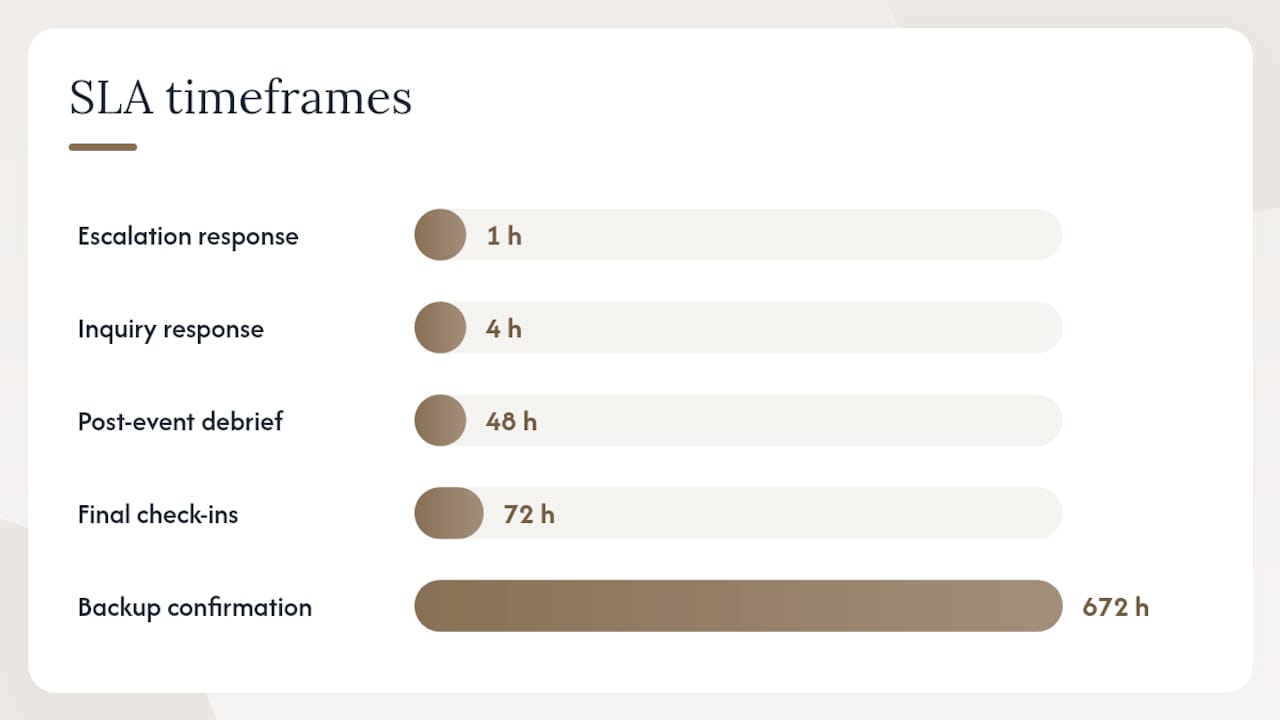
- Inquiry response time: maximum 4 business hours during contracted hours
- Escalation rule: any client complaint or pricing query escalated to the lead planner within 1 hour
- Peak weekend coverage: named backup confirmed in writing at least 4 weeks prior
- Liability clause: supplier carries their own public liability insurance; indemnity scope defined
- Confidentiality: all guest and couple data treated as confidential; no third-party sharing without written consent
- GDPR compliance: data processed only for the contracted purpose; deletion or return of data on contract end
- Reporting cadence: weekly written update during active wedding production; post-event debrief within 48 hours
Communication workflow: The lead planner owns all direct client communication. The outsourced partner communicates with vendors and internal logistics only, copying the lead planner on all material correspondence. Check-ins happen weekly during production and daily in the final 72 hours before an event.
A brief GDPR reminder: any outsourced role that touches guest names, contact details, or dietary requirements must operate under a data processing agreement that complies with Central European data protection law. This is not optional and should be a standard clause in every outsourcing contract.
How Dragonfly Dream Weddings uses selective outsourcing
Selective outsourcing at Dragonfly Dream Weddings protects the guest experience across three-day wedding weekends while allowing the planning team to take on additional celebrations without stretching in-house capacity.
The tasks handled by trusted external partners include:
- Vendor coordination and supplier outreach for catering, floristry, music, and photography
- RSVP tracking and guest communication logistics
- Timeline and run-sheet drafting, reviewed and personalised by the in-house coordinator before client delivery
- Travel and accommodation liaison for guests using nearby properties
What stays firmly in-house: creative direction, couple consultations, on-site lead coordination, and every decision that shapes the personal character of the weekend. The Rose Pool reception logistics, multi-day itinerary sequencing, and accommodation management for on-site guests are handled by the Dragonfly team directly, because these are the moments that define the experience.
External logistical support reduces on-site pressure and improves guest satisfaction across multi-day events. For a three-day wedding weekend hosting up to 100 guests, with boutique on-site accommodation for up to 20 and additional guests staying nearby, the logistics are genuinely complex. Outsourcing the process-driven elements means the in-house team is present and focused where it matters most.

Pro Tip: If you are a planner considering a partnership with a destination venue, ask specifically which logistics the venue team handles in-house and which they coordinate through trusted local suppliers. That clarity prevents duplication and protects the couple's experience from the first planning call to the farewell brunch.
Planners interested in discussing how the Dragonfly model works in practice are welcome to book a private viewing or request the planning brochure directly.
What experienced planners have learned about outsourcing
The most durable lesson from working in this industry is that outsourcing works when the systems come first. Handing over a task before you have documented how you do it yourself does not save time; it creates a training problem on top of an operational one.
Outsource the predictable work: the tasks that follow the same steps every time, that do not require your judgement, and that a well-briefed person with the right tools can execute reliably. Protect the couple-facing moments: the calls where trust is built, the decisions where your experience genuinely changes the outcome, and the on-site hours where your presence is the product.
Measure the impact after 90 days. Check response times, booking conversion, and client feedback. If the numbers have not moved, the problem is usually in the brief or the SLA, not in the principle of outsourcing itself.
Dragonfly Dream Weddings: a venue built for planners who think this way
For planners who want to delegate logistics with confidence, Dragonfly Dream Weddings offers something most venues do not: a fully supported three-day wedding weekend where the venue team handles the operational complexity, and you retain the creative relationship with your couple.
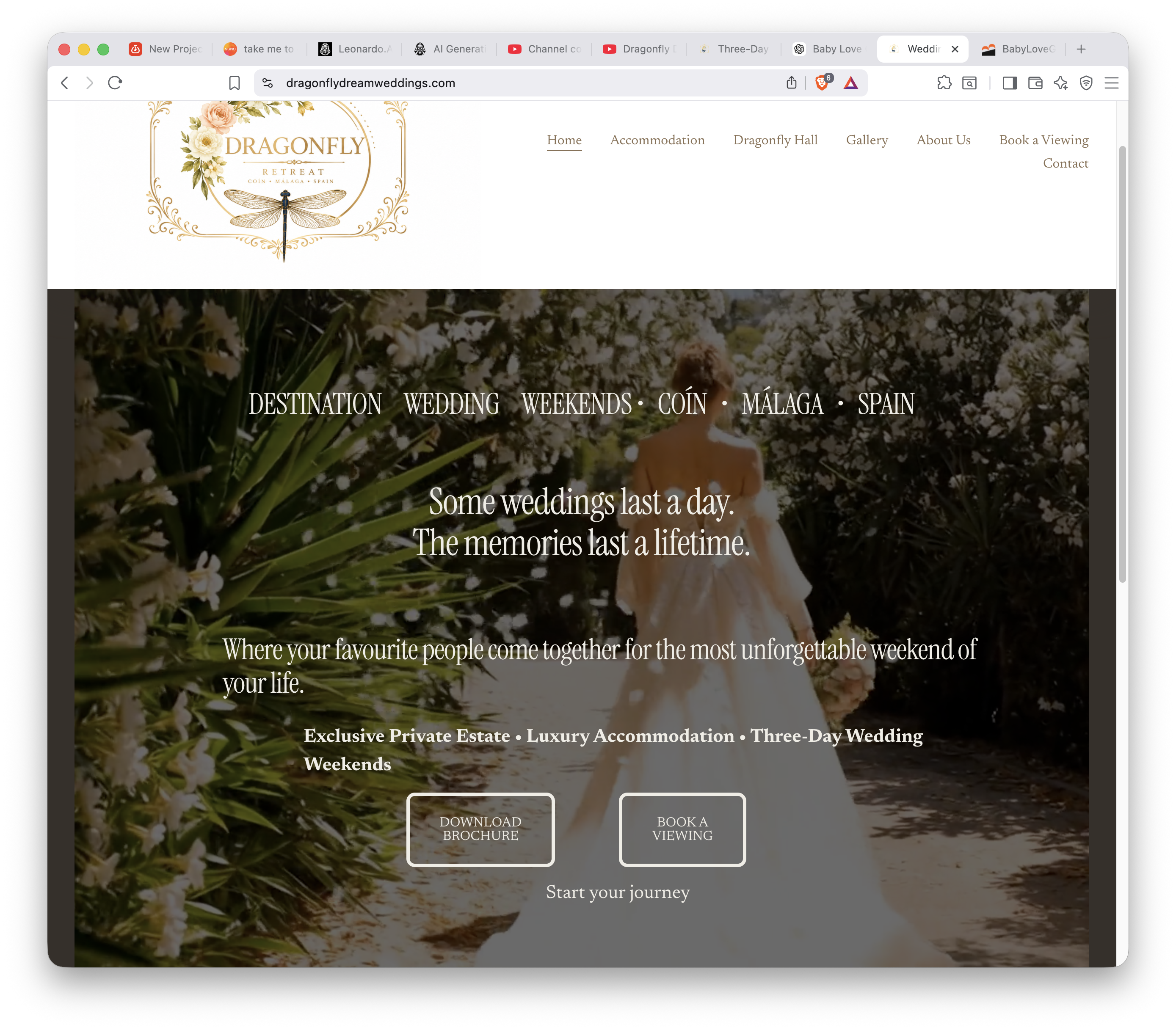
The three-day wedding packages at Dragonfly include access to a trusted network of local suppliers across catering, music, floristry, and photography, boutique on-site accommodation for up to 20 guests, additional accommodation nearby for larger groups, and personalised planning support from an in-house coordinator. The Rose Pool, Dragonfly Hall, and Mediterranean gardens provide the setting; the operational infrastructure means planners arrive with a brief, not a to-do list.
For planners exploring destination wedding partnerships in Southern Spain, the practical next step is a private venue viewing or a conversation about the planning brochure. Both are available to book directly through the Dragonfly website.
Sources
- Outsource vs in‑house: what to keep in your workflow and what you can hire help for
- Common scaling mistake wedding businesses
- Wedding Planner Virtual Assistant: Tasks, Cost & Hiring
- Festive Meal Offerings List for Event Planners in 2026 – Wild Foodz by Hotel Entree Brugge
FAQ
Is it worth hiring a wedding planner or outsourcing coordination?
For most planning businesses, yes. Outsourcing process-driven tasks to a VA or specialist frees the lead planner for billable creative work, and the cost of support is typically recovered through one additional booking per season.
What tasks do wedding planners most commonly outsource?
Inquiry triage, vendor coordination, RSVP management, timeline drafting, and bookkeeping are the most commonly delegated tasks, because they are process-driven and do not require the planner's direct creative judgement.
What should a contract with an outsourced wedding supplier include?
At minimum: response time SLAs, a named backup for peak weekends, public liability insurance requirements, a confidentiality clause, and a GDPR-compliant data processing agreement covering all guest information.
When is the right time to start outsourcing in a wedding business?
The clearest trigger is a missed or delayed inquiry due to workload. Allow six to eight weeks to onboard a new partner before peak season, and run a three-month pilot on a single task before expanding the arrangement.
How does the 50/30/20 rule apply to wedding planning budgets?
The 50/30/20 framework splits a wedding budget across essentials, experience, and flexible extras, helping planners and couples identify where coordination and outsourcing costs sit within the overall spend.